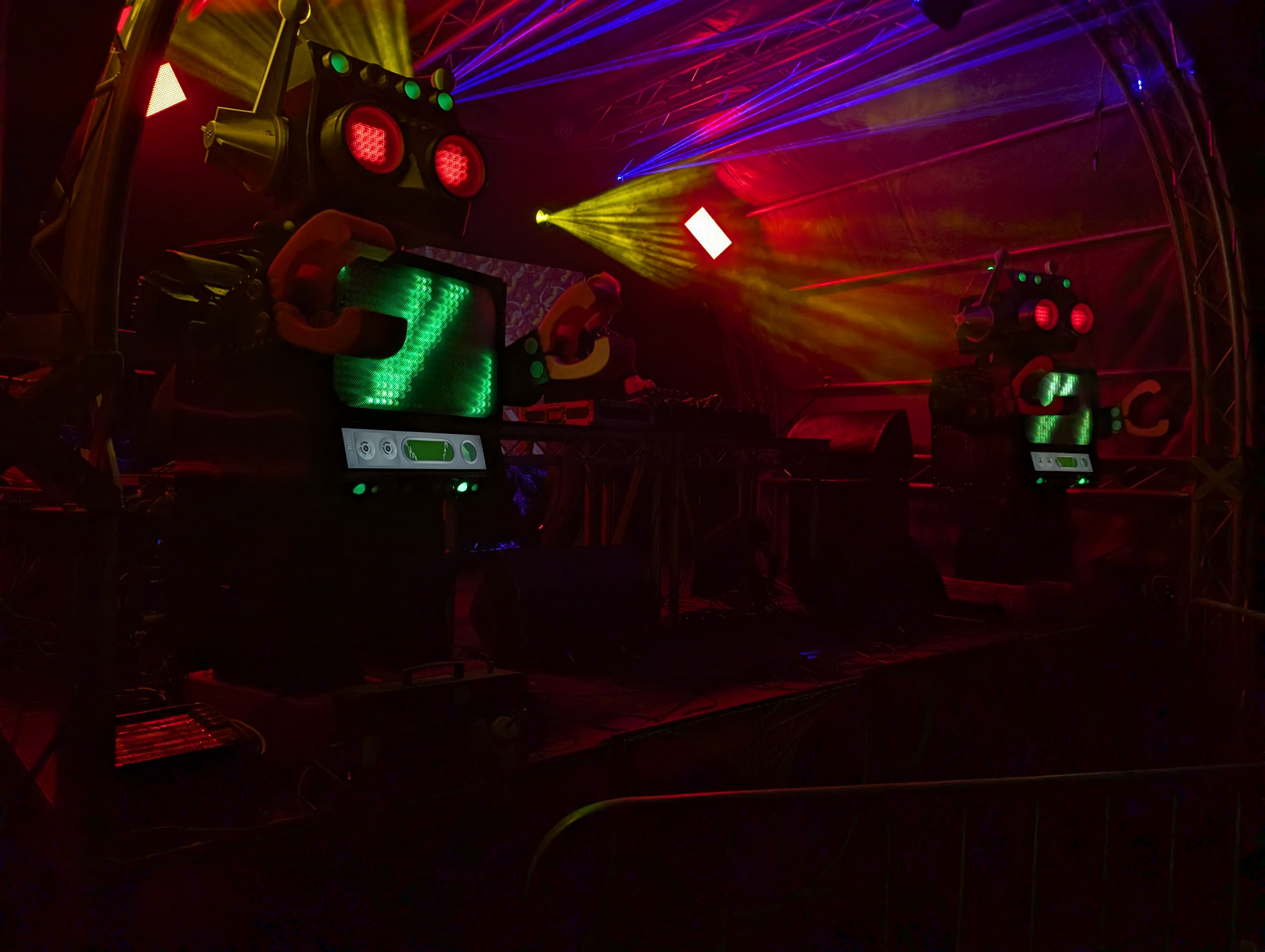
This is a slightly delayed write-up from Utopia Frequency back in July 2025 - and it’s not the glossy version. It’s the version my brain actually wants to record: what I tried, what I learned, and the bits that made me go “right, noted” in permanent marker.
It was the first proper festival outing for Disco Robots. And the important context is: the software wasn’t quite finished. I’d got it to the point where it worked, but it wasn’t “done done”. So I did what any sensible person would do… I finished it in the field and then started programming movement macros on the fly.
Yes, that means I was effectively iterating the behaviour system in public, surrounded by noise, tiredness, and a schedule that does not care about your Git commit history.
Three nights, three versions of the robot
The weekend turned into a very structured experiment (because of course it did): each night I pushed the robots a little further than the night before. Not in a reckless way — in a “let’s expand the safe envelope and see where it tears” way.
- Night 1: keep it conservative, make sure everything survives, get the basics landing with the crowd.
- Night 2: start introducing bolder moves, sharper timing, more “performance” rather than “presence”.
- Night 3: push into the edges, find the hard limits, and accept that I might pay for it mechanically.
I learned the hard way what the robots can and can’t do. Not hypothetically. Not “I suspect”. Mechanically.
Sunday morning: the servo reality check
By Sunday morning I was doing what every robot builder recognises as a completely normal activity: replacing a couple of servos. It’s not a failure, it’s data. It’s the robot politely informing you that your confidence has exceeded your torque budget.
There’s something very clarifying about a festival environment. In the studio you can baby things. On a stage, you find out what’s real. What holds up, what drifts, what binds, what overheats, what can’t take repeated load at a particular angle. All the boring engineering truths turn up and stand directly in front of you.
What this taught me (the useful part)
- Macros are everything. If I can trigger a reliable “big readable moment” instantly, the robot feels alive. If I’m manually nudging things, it feels like… a project.
- Festivals punish subtlety. Big movement and clear timing wins. Tiny cleverness is for me, not for a crowd.
- Iteration beats perfection. Three nights in a row was the perfect format: deploy, observe, adjust, repeat — with increasingly better behaviour each night.
- Mechanical limits aren’t theoretical. You can only “push it a bit” so many times before it pushes back with a burnt geartrain.
Why I’m genuinely happy about all of this
Because this is what I actually needed. Not another studio test. I needed a real event where the robots had to operate in the conditions they’re being built for.
Utopia Frequency confirmed the core idea: this works. People respond to it immediately, and the robots change the feel of a stage. Now it’s “just” the engineering grind of making it more repeatable, more tourable, and less dependent on me doing live surgery on a Sunday morning.
Next steps (aka: the list that will not leave my head)
- Build a library of reliable macros that cover the main musical moments (drops, builds, accents, resets).
- Better safety envelopes in software: limit ranges, limit acceleration, stop me being overconfident at 2am.
- Ruggedise the high-stress joints and treat consumables as consumables (because they are).
- Speed up deployment: labelled looms, fewer decisions, fewer “where’s that cable” moments.
Same energy, less chaos. Ideally.