MODULAR
Each box is a self-contained 30 × 30 cm module. Use one on its own or combine multiple boxes into a larger display.
Modular LED pixel boxes built for live visuals, installations and the robots.
Each box is a 30 × 30 cm, 9 × 9 pixel module. Sixteen have been built so far, designed to work individually or combine into much larger arrangements.
The idea is deliberately simple: a relatively low-resolution grid of very bright pixels, turned into a flexible physical display system.
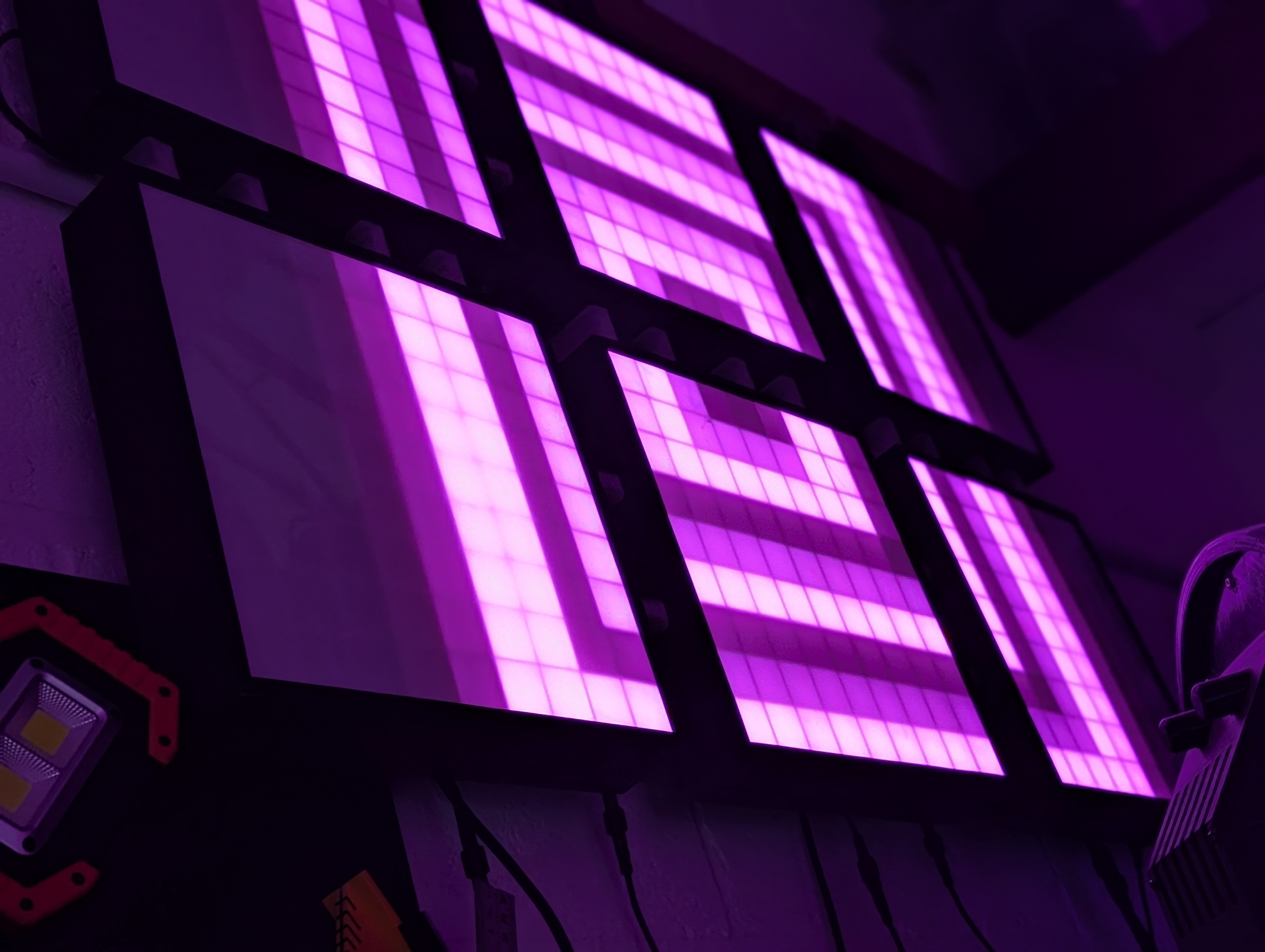
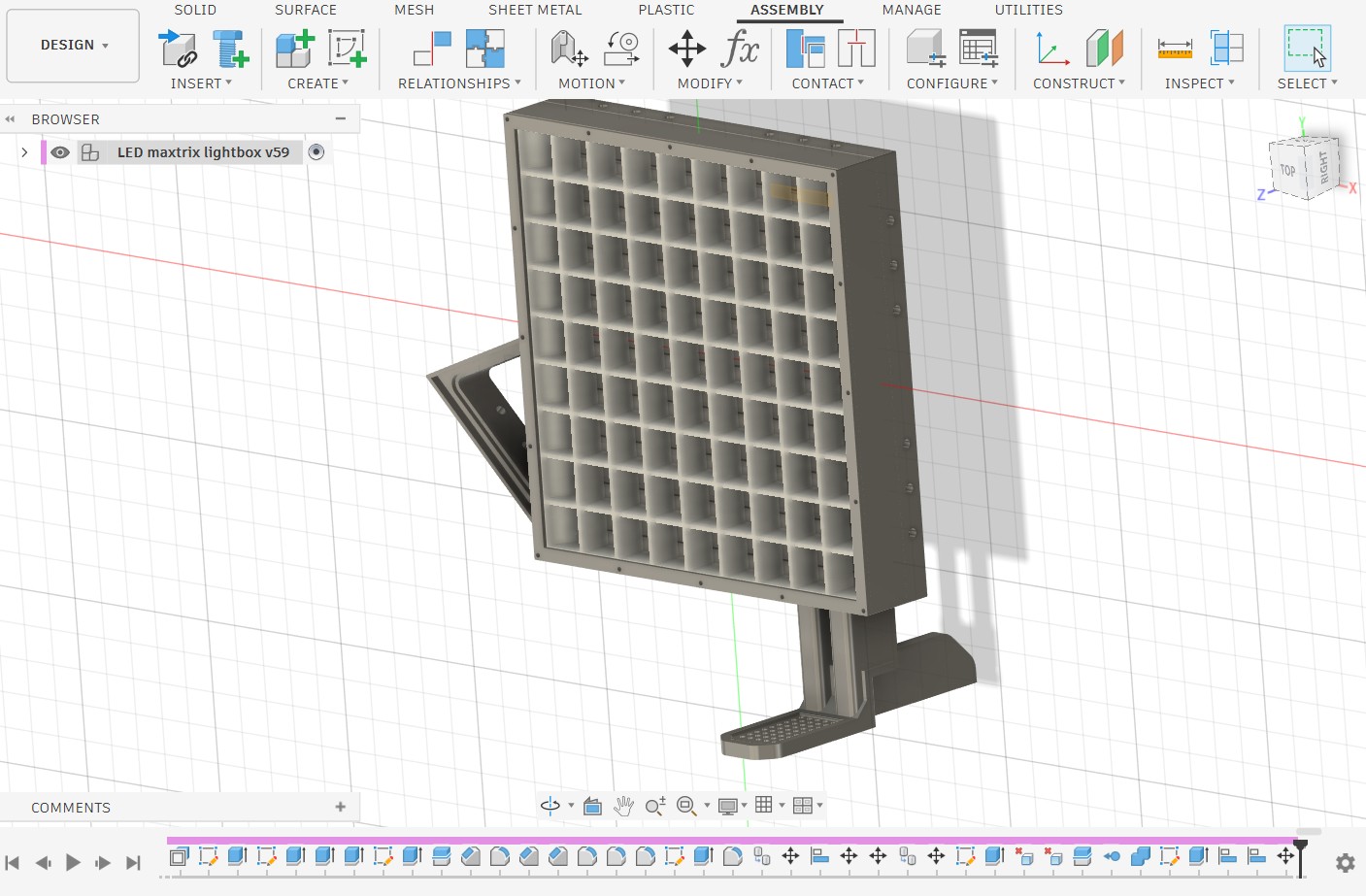
Each box is a self-contained 30 × 30 cm module. Use one on its own or combine multiple boxes into a larger display.
Pole mounted or free-standing, with interchangeable brackets, angles and spacer sizes.
Each box runs WLED on an ESP32 and can work alone or as part of a mapped system.
Overscan software controls MadMapper using OSC; mapped output reaches the boxes over Art-Net.
Rows, columns, grids, clusters or irregular layouts, adapted to each installation.
PHYSICAL DISPLAY SYSTEM
The pixel boxes were designed and built by Overscan as reusable modules rather than as one fixed installation.
They can be pole mounted or used free-standing. A flexible system of brackets, angles and spacers in different sizes means the same boxes can be assembled into rows, columns, grids, clusters or more irregular arrangements.
The physical arrangement is part of the design. Changing the spacing, height and angle of the boxes can produce something quite different without having to build a new display from scratch.
DELIBERATELY LOW RESOLUTION
These aren't intended to imitate a high-resolution video screen.
The deliberately coarse 9 × 9 grid produces blocks of light, colour, patterns and movement. At a distance the individual boxes can become part of a larger image or animation; up close, the physical pixels remain clearly visible.
That low resolution is part of their character rather than a limitation to be hidden.
FABRICATION / ASSEMBLY
Each 30 × 30 cm module contains an individual 9 × 9 LED matrix behind a physical grid and diffuser.
The boxes use a mixture of fabricated and 3D-printed parts and have been designed to be practical show equipment: reusable, repairable and straightforward to reconfigure.
The mounting system includes interchangeable brackets, spacers and angled components, allowing the boxes to be positioned in different ways without modifying the modules themselves.
Each box is a self-contained 30 × 30 cm module.
Use one on its own or combine multiple boxes into a larger display.
The boxes can be pole mounted or free-standing.
Different brackets, angles and spacer sizes allow the same modules to be assembled into very different physical arrangements.
Each pixel box has its own ESP32 running WLED.
At their simplest, the boxes can be used as a standalone WLED system, either individually or grouped together over the network.
For larger installations they can receive Art-Net data from MadMapper, allowing multiple boxes to become parts of a much larger mapped visual surface.
SOFTWARE / SIGNAL FLOW
In a full Overscan setup, my custom software controls MadMapper using OSC.
MadMapper maps the visual output across the pixel boxes and sends the resulting data to them over Art-Net.
This means the same modules can work as simple standalone WLED lights or become part of a much larger coordinated system alongside projection, lighting and the Disco Robots.
ONE SYSTEM / MANY FORMS
Rows, columns, grids, clusters or deliberately irregular layouts.
The arrangement of the boxes can change from one installation to the next, rather than the project being tied to a single fixed configuration.
The combination of modular boxes, different spacer lengths and angled mounting parts means the physical layout itself can become part of the visual composition.
EQUIPMENT / ARTWORK
Like a lot of Overscan projects, the pixel boxes sit somewhere between equipment and artwork.
They are useful pieces of show hardware, but the boxes themselves, the visible pixel grid and the way they are arranged in space are also part of how the work looks.
The modular mounting and control systems mean an installation can be adapted to the space rather than having one permanent form.
FROM THE STUDIO
New layouts, mounting experiments, build changes, WLED experiments, diffusion tests and examples of the boxes being used.
Loading Pixels news…