I love Teenage Engineering kit. I've got several of their Pocket Operator synthesisers that I acquired on eBay and love playing with them. But this article has nothing at all to do with that. It's quite literally about teenage engineering where the teenager in question was me.
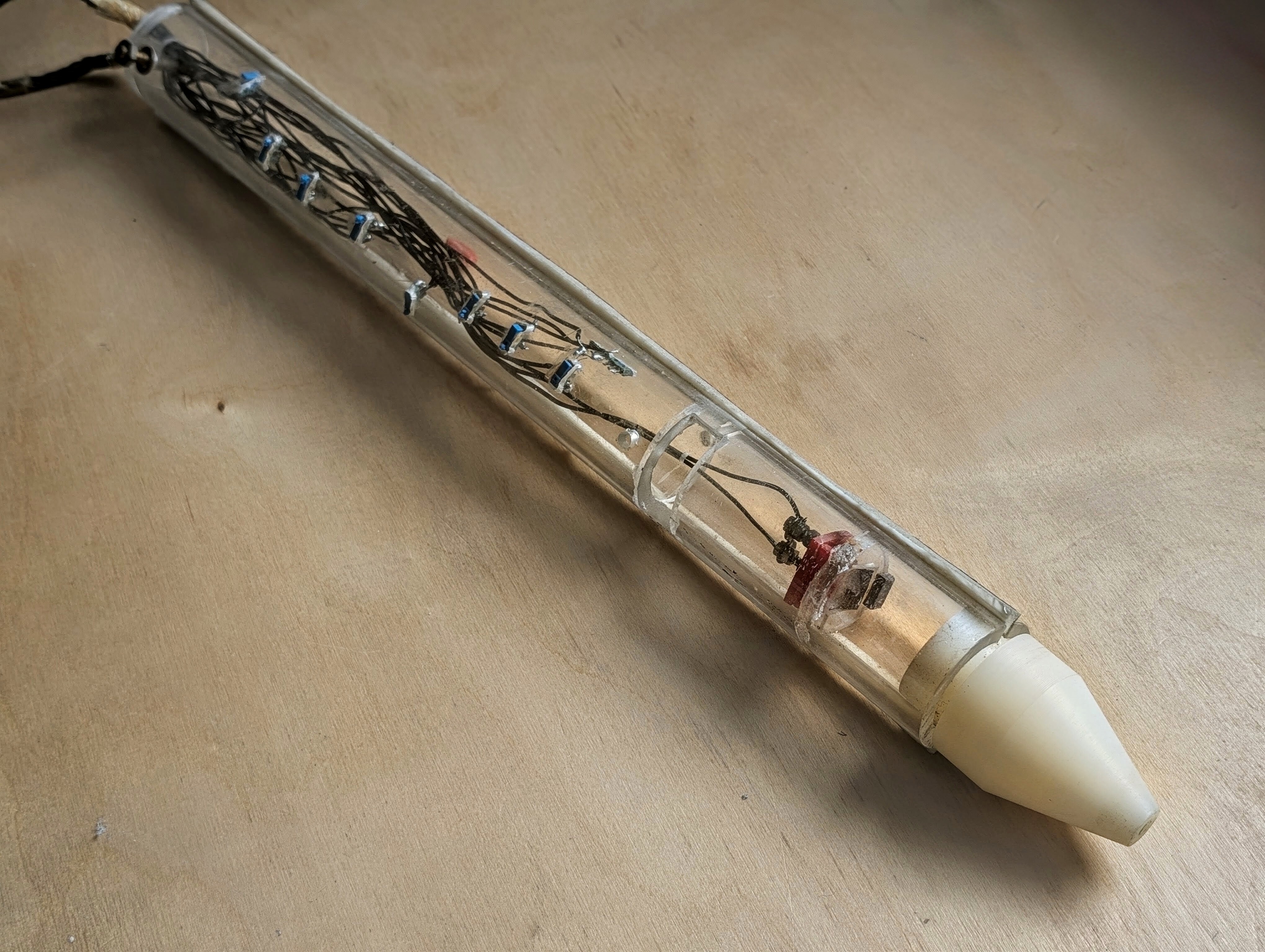
Long before I had any sensible reason to describe something as "physical computing", I made a wind controller when I was 15 or 16. It was my first proper electronics project and, looking back, probably my first attempt to make software respond to something happening in the physical world. The project was built around an Atari 800XL, a clear acrylic tube, a collection of switches, a home-made breath mechanism, and a great deal of making things up as I went along.
I do not want to retrospectively turn teenage tinkering into some grand master plan. It was a doodad. I was messing about. But the basic impulse is very familiar: I wanted something that did not exist, so I tried to build it. Instead of interacting with a computer only through a keyboard or joystick, I wanted to make a physical object become an input to software. Nearly forty years later, that still sounds suspiciously like the sort of thing I spend my time doing.
Why I wanted one
I should probably explain why I wanted a wind controller at all. I was deeply jealous of friends who played piano. If you could play piano, it seemed to me that you could just move sideways onto a synthesiser and suddenly you were on the road to New Order or Depeche Mode.
I, on the other hand, played the oboe. This was not the result of some profound calling. My mother had asked about me learning an instrument at school and, by the time she did, the oboe was literally the only instrument left. So I played the oboe. We did not own a piano, so there was no obvious keyboard route either.
As a teenager obsessed with electronic music, this felt deeply unfair. I could perhaps have moved from oboe to saxophone, but in my head that road led to Kenny G.
I did not want Kenny G. I wanted The Art of Noise.
The wind controller was my attempted escape route. If I already knew how to play a wind instrument, perhaps I could build something that used those physical skills to control electronic sound instead. Rather than learn the keyboard route into synthesis, I tried to engineer my own route into it.
Mr Dean and the moonlighting school project
The wind controller was technically my school technology project, but my actual technology teacher had no idea I was making it. I hated his lessons and did almost nothing in them. I remember him as a nasty creep who seemed far more interested in the teenage girls than the boys, and my experience of him was mostly having whatever I was doing dismissed as rubbish. I am not going to name him.
The slightly ridiculous part is that I built the controller in exactly the same DT labs, just not during school lessons. The school also ran a youth centre there, and the teacher who stayed behind every day was Mr Dean. Absolute legend. He was the complete opposite. He treated my ideas as things worth pursuing and, once I had been shown how to use the equipment, essentially told me I could get on with it. I was trusted to use pretty much anything in the workshop unsupervised.
So my official school technology project became a kind of moonlighting operation. I did the real work at youth centre, in the same room and on the same machines, while the teacher who was actually supposed to be teaching me remained completely unaware of it.
That freedom was enormously important, although in hindsight perhaps a little too free. I made the mouthpiece from a block of nylon that I turned on a lathe. I had been given a brief induction and had been very clearly warned that under no circumstances should the lathe be switched on with the chuck key still in place. There were even large signs reminding you of this. The reason, of course, is that the chuck key is a chunky lump of steel and the lathe will throw it across the room at considerable speed.
Naturally, I managed to switch the lathe on with the chuck key still in it.
It flew out and narrowly missed my head. It was a very direct and memorable demonstration of why the warning existed. The same freedom that allowed me to make the controller also came remarkably close to ending the story rather earlier than planned.
Those little blue fuckers
The body of the controller was a length of clear acrylic tube, with switches running along it for the fingers. My brother was tasked with buying the microswitches and was sent off with some money to Garland's in Deptford, our local electronics shop. Local electronics shops were a thing then. You could actually walk into one and come home with switches, components, connectors and whatever other bits of electronic detritus you needed.
In my head, I was expecting him to return with some reasonably robust circular switches. I would drill a row of round holes in the acrylic tube, pop the switches in, and the job would be done.
He came back with those little blue fuckers.
They were tiny, rectangular and prone to breaking. A round hole is easy. A tiny accurate rectangular hole in a curved acrylic tube is very much not. I spent an enormous amount of time with needle files, drilling a starting hole and then slowly filing each opening into a rectangle until a switch would fit. Then I got to do it again for the next one. And the next one.
The surviving controller still has the little blue switches all the way down it, so every time I look at it I can see a row of tiny reminders of just how much filing was involved.
The breath switch
The cleverest bit of the controller was probably the breath switch, although I should immediately ruin any impression of teenage engineering genius by admitting that a lot of its success was luck rather than judgement. Much like quite a lot of my work today.
My grandfather helped me fabricate it. He had some very thin steel sheet, which we used to make a tiny flap, and a piece of equally tiny steel rod that became its hinge. He also supplied a small permanent magnet, which we glued into place with epoxy.
Somehow, the thing was a marvel.
The flap was light enough that my breath could push it away from the magnet, but the magnet was just strong enough to pull it back again when I stopped blowing. I certainly did not calculate any of this. We made it, glued the magnet on, tried it, and by an extraordinary piece of luck the forces were about right.
The really lovely part was that it worked at any angle. If I had relied on gravity to return the flap, the controller would only have behaved properly when held in a particular orientation. Because the magnet supplied the return force, I could hold the instrument level, tilt it or point it around and the breath switch still worked. That was not a feature I had carefully engineered in advance, but once it existed I was more than happy to take the credit.
The Atari end
The other half of the instrument was software. The controller plugged into both joystick ports on my Atari 800XL. Each joystick port gave me four direction inputs plus the trigger, so across the two ports I had ten digital inputs available in two groups of five.
In Atari BASIC I could read the direction lines using STICK and the trigger using STRIG. STICK returned 15 when nothing was pressed, while STRIG returned 0 when the trigger line was active and 1 when it was released.
That was the basic trick behind the whole thing. Each hand used one joystick port. Four fingers were wired to the four directional inputs read by STICK, while the fifth finger used the joystick fire-button input read by STRIG. So five fingers gave me the four directions plus fire, repeated across the second port for the other hand: ten finger switches in total.
Fingering a note meant pressing combinations of those switches, which produced STICK values that an actual joystick would not normally generate. After all, who ever managed to push a joystick up and down at the same time? I was taking something intended for joysticks and using it as a general-purpose physical interface.
The sound at the other end was much less sophisticated. The Atari was producing a very basic square wave through its POKEY sound chip. The interesting bit, at least to me, was the interface rather than the magnificence of the synthesis.
The BASIC listing in the project folder is not a fragment or a sample. It is the whole program, and it was never finished. The live playing part worked, but as far as I can remember it never actually recorded anything. The icon-driven screen had controls for recording, tune editing, playback, deleting and moving through stored music, but at that point quite a lot of the graphics were essentially for show. I genuinely intended to pursue it and make those parts work properly.
Then Casio happened.
The report, the award and the punchline
The school report makes the whole story considerably funnier.
My final year technology report is dated 13 March 1987. It says that I had a good grasp of the principles used in solving problems of a technological nature
, but then concludes that I did not seem prepared to investigate the problem further than an initial idea.
Meanwhile, unknown to the teacher writing the report, I was spending my evenings in the same workshops building a physical electronic instrument, fabricating parts, working out a breath mechanism, wiring ten digital inputs into an Atari, and writing an icon-driven program to play, record and edit music.
I was told only a day or two beforehand that I was getting the award, and I was frankly pretty stunned. I had been convinced another kid would get it. In my mind he had made something genuinely amazing: his own custom accelerometer that plugged into a BBC B computer. I remember thinking his project was far cleverer than mine.
Perhaps the distinction was that his accelerometer was one remarkable part of a larger idea, whereas mine had somehow become a whole thing: mechanics, electronics, physical interface, software and an instrument you could actually play. That is only my retrospective guess. I have no idea what the judging discussion was.
On 22 May 1987, a little over two months after that report, the wind controller won the Head's Special Award for Technology.
This was also my O level technology project and, despite all of that, I only got a B.
Even better, the project folder was kept by the school to be used as a teaching aid.
I can only hope he was seething.
And then Casio ruined everything
When I left school, the project met a rather ordinary end. For my 17th birthday my father took me to Len Stiles Music in Lewisham to choose a keyboard. I was desperate for some sort of MIDI synth and came home with a second-hand Casio CZ-230S.
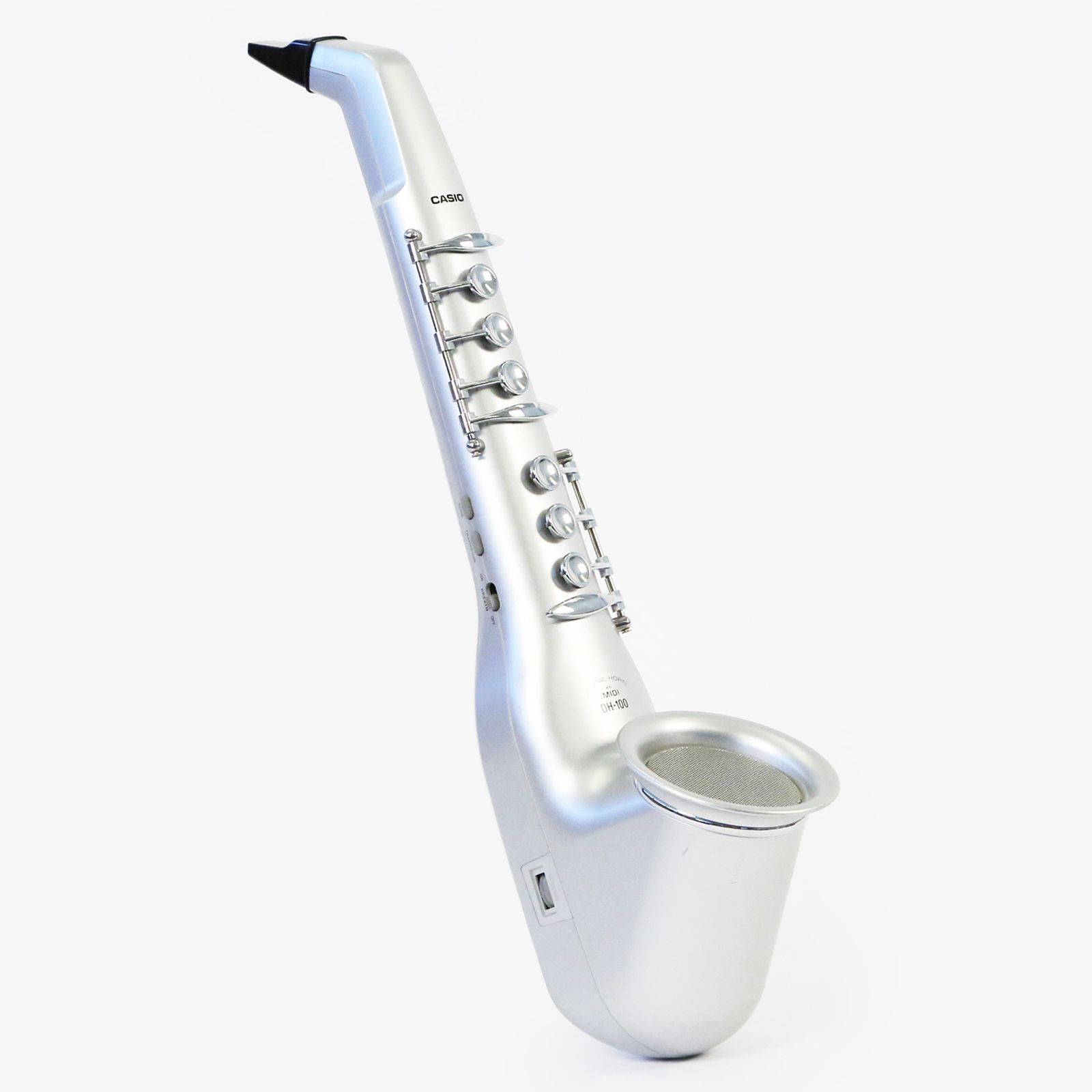
At the same time, sitting there in the shop, was a Casio Digital Horn. My reaction was basically: WTF? How can that exist? I had just spent months making my own breath-controlled electronic instrument out of acrylic tube, microswitches, a magnetic flap and an Atari, and here was a mass-produced version of roughly the same idea sitting on a shelf in Lewisham.
More money changed hands. I took the horn home too, along with a MIDI cable to connect it to the CZ, and that was more or less the end of my own controller as an active project. Why keep pushing the home-made version when an actual commercial digital wind instrument had just appeared in front of me?
Except the Casio horn itself was a bit meh. The switches were a little slow, it never quite lived up to the shock of discovering that it existed, and before long I shoved it on a shelf and mostly forgot about it. Ironically, the commercial instrument that killed my desire to develop my own controller turned out to be less interesting to me than making the home-made one had been.
I did keep going to the youth centre for a while, although by then the workshop was not the only attraction. I was totally besotted with a girl who also hung out there. That particular project was even less successful.
And, for the avoidance of doubt, I do not hold Casio responsible for the unrequited love.
What survived
Rather amazingly, the controller itself still exists. I also kept photocopies of the project folder, which I have now scanned, along with the original award and the school report. Looking at them together nearly forty years later is quite strange. The memories are one thing, but there is the actual object, the original drawings, the description of how the Atari was connected, the software listings, the award, and the report that managed to misunderstand what I was doing almost perfectly.
The project is interesting to me now for reasons that go well beyond the electronics. It captures a particular world. A teenager could be trusted with a school workshop after hours, sent to use machinery after a fairly brief induction, send his brother to a local electronics shop with cash to buy components, rope his grandfather into fabricating a tiny magnetic flap, and then connect the whole strange contraption to an 8-bit home computer.
Some of that freedom was fantastic. Some of it was objectively dangerous. Quite a lot of the engineering was improvisation, persistence and dumb luck. But one thing does stand out very clearly: the difference made by an adult who simply treated the idea as worth pursuing.
Mr Dean did not design the controller for me or tell me how to build it. He gave me access, trust and permission to find out whether the stupid thing in my head could actually be made.
It could.