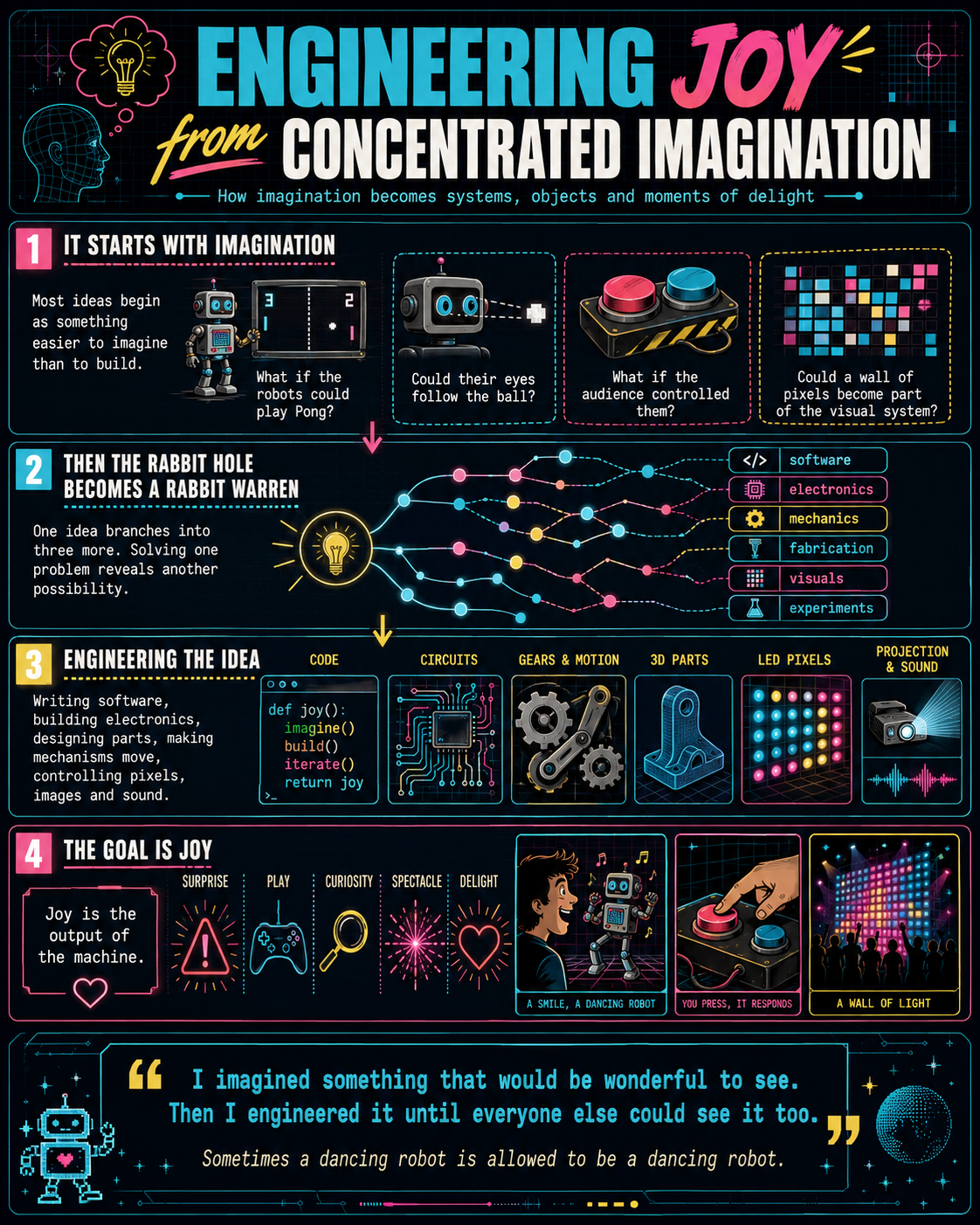
I came up with the phrase “Engineering joy from concentrated imagination” because I needed a few words to describe what I do.
The slightly surprising thing is that, the more I thought about it, the less it felt like a piece of branding and the more it felt like a fairly literal description.
The engineering part is obvious enough.
I write software. I build electronic systems. I design and fabricate things. I make mechanisms move, LEDs flash, projectors throw images across buildings and computers talk to one another. I spend unreasonable amounts of time thinking about brackets, bearings, power supplies, network protocols, pixels, servos and why something that worked perfectly yesterday has suddenly decided not to work today.
But the engineering isn't really the point.
The point is what happens at the other end.
Someone sees a six-foot robot dancing and smiles.
Someone presses a huge coloured button and discovers that they've made something unexpected happen.
A wall suddenly fills with light.
An image responds to music.
Something ridiculous appears on a screen.
For a moment, somebody is surprised, amused or curious.
That's the bit I'm actually trying to make.
So in that sense, joy is the output of the machine.
The other half of the phrase, “concentrated imagination”, probably describes the process that leads to it.
Most of the things I make begin with an idea that is considerably easier to imagine than it is to build.
Wouldn't it be funny if the robots could play Pong?
Could their eyes follow the ball?
What if the audience controlled them?
Could I make a physical wall of pixels that behaves like part of my visual system?
Could I recreate the ridiculous multilayered video setup we used in the 1990s, except inside a web browser?
And once an idea gets lodged in my head, I have an unfortunate tendency not just to disappear down a rabbit hole, but to excavate an entire rabbit warren.
One idea branches into three more. Solving one problem suggests another possibility. A bit of software written for one purpose suddenly makes something else possible. A mechanical solution becomes the starting point for another object. I find a component I didn't know existed and immediately start wondering what else I could do with it.
Pretty soon the original idea has acquired a whole family of sub-ideas, experiments and unnecessary complications.
One problem leads to another. That leads to learning something new, writing some software, designing a part, printing something, discovering that the first version was a terrible idea, changing it and trying again.
Eventually a rather large collection of technology disappears behind something that hopefully looks simple.
Robot dances.
That's the concentrated bit.
Behind that apparently simple result is a strange accumulation of things I've picked up over more than thirty years: graphic design, animation, live visuals, club culture, coding, electronics, 3D modelling, fabrication, networking, old computers, toys, science fiction and whatever else happens to have caught my attention along the way.
I don't really separate those things in my head.
They're just a collection of materials I can think with.
And I think that's an important part of how I work. I don't generally start with a piece of technology and ask what artistic meaning I can attach to it.
I normally start with:
Wouldn't it be great if…
Then I have to work out how to make it exist.
Sometimes that means writing software. Sometimes it means building electronics or mechanical parts. Sometimes it means making images. Quite often it means doing all of those things at once.
There doesn't necessarily have to be a deeper message hiding underneath it.
Sometimes a dancing robot is allowed to be a dancing robot.
I like spectacle. I like play. I like things people can understand without being given an explanation first. I like work that makes people curious enough to walk towards it rather than feeling they need permission to engage with it.
Of course, people are free to find their own meanings in anything I make. But my starting point is usually much simpler.
I imagined something that I thought would be wonderful to see.
Then I engineered it until everyone else could see it too.
Engineering joy from concentrated imagination.