For a year or two before I got my ZX Spectrum, I'd already become slightly obsessed with computers. I used to pore over the adverts in New Scientist for the ZX80, and then the ZX81, without really understanding what on earth I would actually do with one if I had it. I was just drawn to the idea of a computer, rather like a moth to a flame.
And yes, in retrospect, there is probably something slightly odd about an 11-year-old reading New Scientist closely enough to become obsessed with Sinclair computer adverts. But something about these little machines fascinated me long before I really understood what having one would mean.
Then, at around 12, I finally got a ZX Spectrum. But having a computer and knowing what to do with one were two different things. That was where Easy Programming for the ZX Spectrum came in.
I don't actually remember where the book came from. My parents may have bought it for me, or perhaps it came from my older brother. What I do remember is what it did. It was the first thing that opened my eyes to the fact that I, a 12-year-old kid, might actually be able to program a computer. Programming wasn't some mysterious activity carried out by people who already knew incomprehensible things. It was something I could learn to do myself.
It was achievable. It was possible. And, for me anyway, it was fun.
I could type something in and make something happen, then change it and make something different happen. But the bits that really grabbed me were the graphics. I could put things on the screen, move them around, animate them and, most excitingly, make my own graphics.
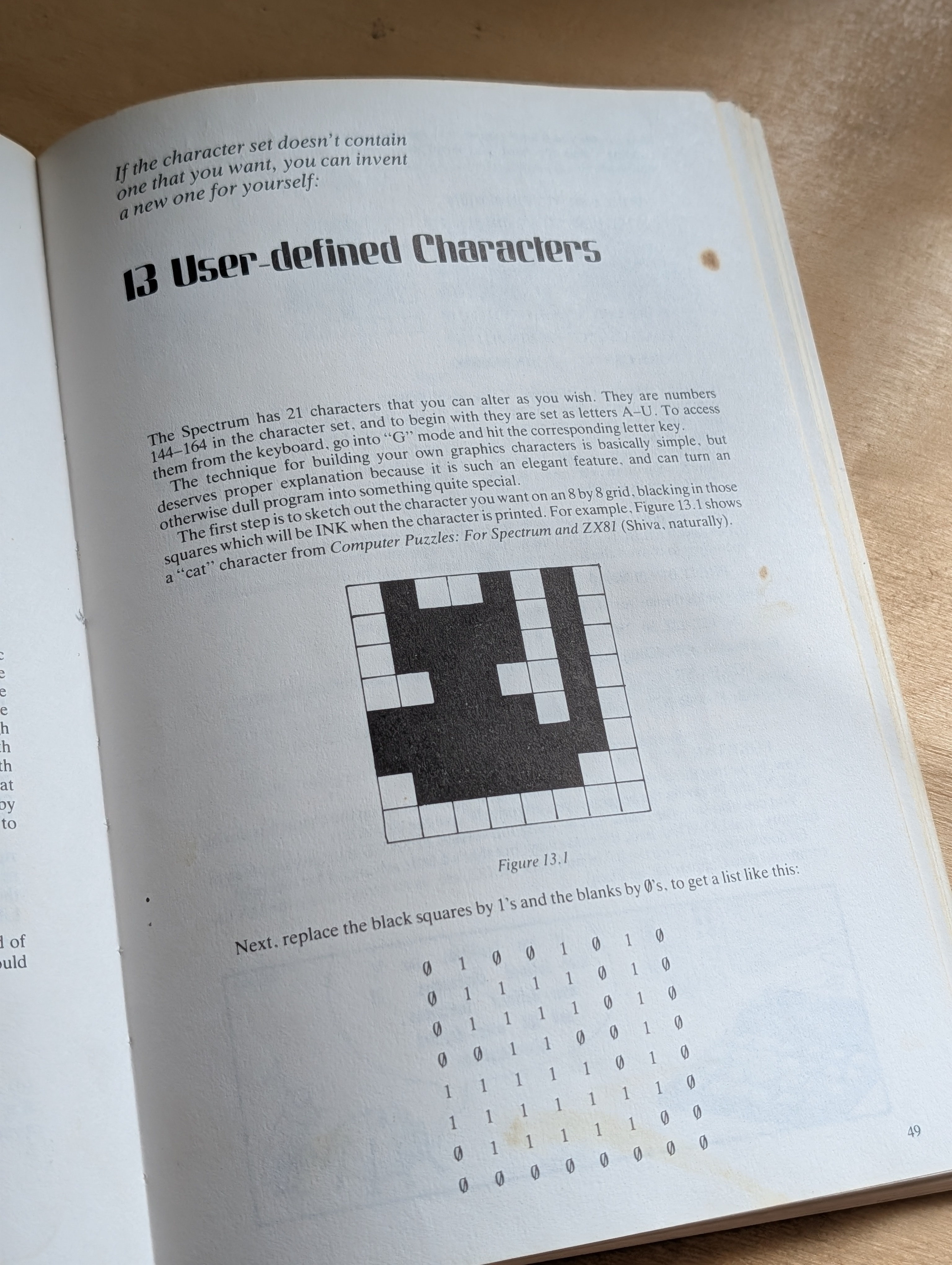
There's a chapter in the book about user-defined characters. The Spectrum let you define your own graphics using tiny 8 × 8 grids, deciding which pixels were on and which were off. At the beginning of the chapter is a sentence that, looking at it again more than forty years later, feels strangely significant:
“If the character set doesn't contain one that you want, you can invent a new one for yourself.”
Something about that grabbed me then, and has never really let go. The computer wasn't just a machine containing things that somebody else had made. I could create my own little world on the screen. I could decide what existed there, what it looked like, how it moved and what happened next.
More than forty years later, the grids are considerably bigger, the pixels are brighter and some of them have escaped from the screen altogether and ended up attached to six-foot robots. The software has become considerably more complicated too. But fundamentally, I'm still doing the same thing: creating my own worlds, making things appear, making them move, experimenting to see what happens and, quite often, building the tools I need because the tool I want doesn't exist.
The Spectrum led to more programming, games and graphics, then Amigas, video hardware, live visuals, increasingly ridiculous multilayered VJ setups, my own visual software, physical pixels and eventually robots. There wasn't some grand plan connecting any of it. One interesting thing simply led to another, and another, and another.
Obviously none of that was in my head when I was twelve. I just discovered that I could make things happen on a television screen, that I could make things which hadn't existed before, and that doing so was enormous fun.
More than forty years later, apparently I still haven't got bored with it.
Looking at this battered old book again, I think this really was the beginning of the beginning.